How Can Wholesale Coffee Packaging Reduce Packaging Costs?
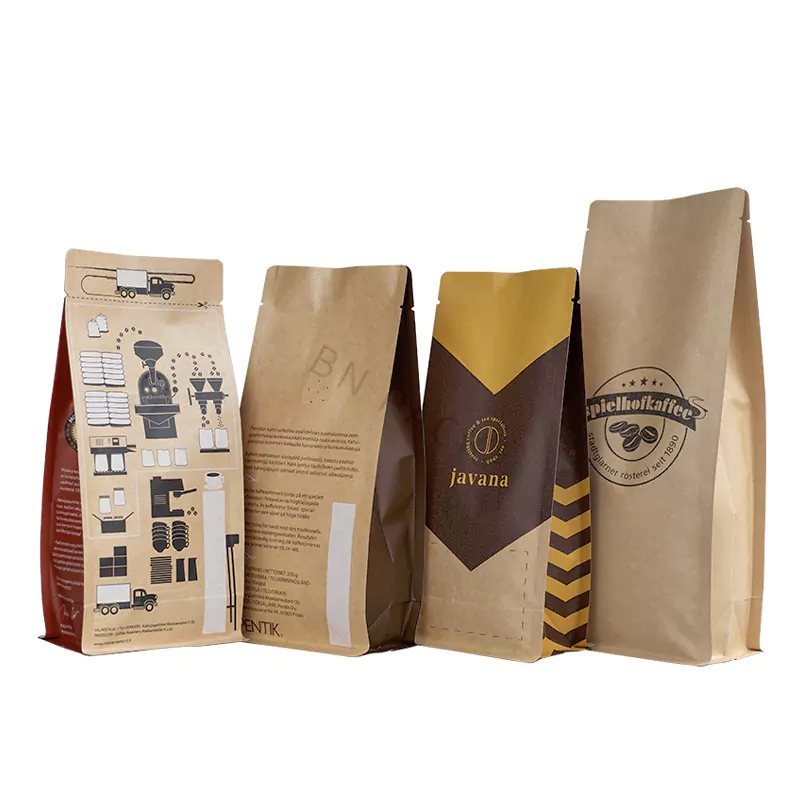
Wholesale coffee packaging lowers cost by spreading setup, printing, freight, and handling expenses across more units. A $1,200 production setup adds $0.12 to each bag at 10,000 units but only $0.012 at 100,000 units. For a roaster using 300,000 bags a year, cutting effective packaging cost by $0.04 per bag saves $12,000 before freight and labor. Larger orders can also reduce shipment frequency, while standardized dimensions improve carton and pallet use. The useful number is cost per sellable packed bag, not the quoted bag price, because sealing waste, obsolete inventory, storage, and damaged coffee can erase a low purchase price.
Wholesale purchasing starts to work when fixed production expenses are spread over enough bags. Printing preparation, press setup, machine calibration, quality checks, plate or cylinder costs, and production changeovers may be similar whether a converter produces 15,000 or 150,000 bags. If setup costs total $1,500, they represent $0.10 per unit at 15,000 bags but only $0.01 at 150,000. That difference matters for a roaster selling several high-volume blends, although buying more packaging than annual demand can move the expense into storage and write-offs.
The order quantity therefore needs to be compared with annual usage rather than supplier price breaks alone. A business using 20,000 bags per month consumes 240,000 per year; a 120,000-unit purchase covers roughly six months, while 300,000 units exceed one year of current demand. If artwork, net weight, certification marks, or product information changes before the inventory is used, part of the discount disappears. A 7% write-off on 300,000 bags equals 21,000 unused units, so forecast accuracy has to sit beside unit price during purchasing.
That forecasting becomes easier when several products share one package specification. A roaster may sell eight coffees but use the same 250 g pouch dimensions, zipper position, valve location, film structure, and carton size for six of them. Product identity can then be handled through printed versions, labels, or variable information rather than six unrelated bag constructions. Combining demand from six SKUs can move purchasing from a 20,000-unit tier to a 100,000-unit tier while reducing the number of packaging components stored in the warehouse.
Fewer bag formats also reduce production changeovers. If a packing line requires 20 minutes to change guides, sealing temperatures, coding position, and bag settings, eight format changes consume 160 minutes before normal production resumes. Cutting that to four formats saves 80 minutes per cycle. At 12 changeover cycles per month, the annual difference is 192 production hours. Labor rates and equipment costs differ by plant, but the operating effect can be measured without guessing: minutes lost per changeover × number of changeovers × loaded hourly cost.
Material specification is the next place where wholesale volume can either save or waste money. Coffee packaging has to limit oxygen and moisture exposure while remaining compatible with the sealing process. The Specialty Coffee Association’s review of published coffee-staling research reported that vacuum-packed coffee showed a staling rate five times lower than coffee packed in air in one cited study. It also cited research in which nitrogen-flushed coffee reached a six-month sensory shelf life compared with three months for coffee packaged without flushing.
Those results explain why cutting film cost without checking barrier performance can be expensive. Saving $0.02 on a pouch is worth $4,000 across 200,000 units, but a 2% increase in rejected or unsellable packed coffee would affect 4,000 finished units. If each finished unit contains $5 of coffee, packaging, labor, and overhead, the exposure is $20,000. Material reduction should therefore be tested against oxygen transmission, water-vapor transmission, seal integrity, puncture resistance, zipper performance, and the planned shelf-life period.
A cheaper bag is useful only when the filled product passes the same storage, sealing, and handling requirements.
For brands that prefer a paper appearance, kraft paper coffee bags can be purchased in wholesale quantities, but the visible kraft layer should not be treated as the whole barrier system. Coffee protection normally depends on the complete laminate or coated structure, closure design, seal quality, and any internal barrier layer. A buyer comparing two 12 oz kraft-style pouches should therefore request material construction, total thickness, barrier data, valve specification, sealing range, and carton quantity instead of comparing the outside paper finish alone.
Degassing also deserves cost analysis because freshly roasted coffee releases carbon dioxide after roasting. The Specialty Coffee Association describes one-way valves as a method for allowing gas to leave a coffee package while limiting incoming air. Its literature review also discussed a small test involving six flexible bags: properly sealed samples reached 0% oxygen and more than 40% carbon dioxide, although three of the six bags leaked, so the sample was too small for broad conclusions.
That six-bag test is useful for another reason: seal consistency may cost more than the valve itself. If a roaster fills 400,000 pouches annually and seal defects fall from 1.5% to 0.5%, 4,000 additional bags remain usable. A $0.22 empty pouch alone would account for $880, before counting coffee, operators, machine time, rework, and disposal. Buyers should request production samples and run them on the intended filling and sealing equipment before approving a large order.
Printing method can produce similar differences. A conventional print process can become economical at larger volumes because setup cost is divided across more units, while short seasonal runs may be better suited to digitally printed packaging or standard wholesale bags with labels. A roaster producing 150,000 units of one house blend and only 5,000 units of a seasonal release should not automatically use the same printing arrangement for both. The smaller SKU carries 30 times less volume over which to spread artwork and setup expenses.
A practical purchasing comparison can therefore use separate cost columns rather than one “price per bag” figure:
| Cost item | Supplier A | Supplier B |
|---|---|---|
| Bag price | $0.21 | $0.24 |
| Setup allocated per bag | $0.02 | $0.01 |
| Freight per bag | $0.025 | $0.015 |
| Expected packaging waste | 2.0% | 0.7% |
| Effective cost before storage | $0.255+ | $0.265+ |
Supplier A appears cheaper at the invoice level, but the difference narrows once setup, freight, and waste are included. At 250,000 bags, a 1.3-percentage-point waste difference represents 3,250 bags. Filled-product cost then determines whether the lower purchase price still produces the lower annual cost.
Freight deserves its own calculation because flexible packaging is light but occupies space. Ordering five small shipments instead of one or two palletized deliveries adds repeated freight minimums, receiving activity, paperwork, and warehouse handling. If five deliveries cost $650 each, annual inbound freight is $3,250. Two larger deliveries at $1,050 each total $2,100, reducing the example by $1,150. Actual rates depend on distance, pallet density, carrier, fuel charges, and delivery terms, so carton dimensions and pallet quantities should be included in every quotation.
Bag dimensions also affect outbound coffee logistics. Reducing an unnecessarily tall pouch by 15 mm may use less material and allow a different case arrangement. If carton optimization raises case packing from 20 to 24 bags, each carton carries 20% more units. A shipment of 24,000 bags would then need 1,000 cartons instead of 1,200. The saving may include corrugated material, labels, pallet positions, warehouse movements, and freight space, provided the smaller pouch still fills and seals correctly.
Packaging cost also has an environmental material component that increasingly affects procurement requirements. The U.S. Environmental Protection Agency reported that containers and packaging represented 82.2 million tons, or 28.1%, of U.S. municipal solid waste generation in 2018. It also reported a 53.9% recycling rate for the overall container-and-packaging category that year. Reducing unnecessary film area, excessive carton space, or avoidable secondary packaging can therefore lower purchased material as well as disposal volume.
Warehouse cost should be added before choosing the largest quantity tier. A pallet position priced internally at $18 per month costs $216 per year. Forty pallet positions occupied by excess coffee packaging therefore represent $8,640 in annual space cost before insurance, handling, inventory counting, damage, and financing are considered. A supplier offering scheduled releases against a larger annual commitment may allow a roaster to obtain better volume pricing without receiving an entire 12-month requirement at once.
Payment terms can alter the result further. Paying $80,000 for packaging 10 months before it is consumed ties up more cash than receiving four scheduled lots. Even without assigning a financing rate, purchasing teams can compare average inventory value under each arrangement. If quarterly releases reduce average packaging inventory from $60,000 to $25,000, $35,000 less cash remains tied to bags sitting in storage. The benefit can exceed a small difference in quoted unit price.
The same approach should be used for optional features. A zipper adding $0.025 per bag costs $7,500 on 300,000 units. A premium finish adding $0.018 costs another $5,400, while a special closure adding $0.03 adds $9,000. Features should stay when they support storage, consumer use, packing efficiency, product positioning, or documented shelf-life needs. They should not remain in the specification simply because an earlier version of the package used them.
A wholesale agreement works best when the supplier quotation shows more than price. Buyers can ask for minimum order quantity, quantity tiers, artwork charges, cylinder or plate ownership, lead time, production tolerance, carton count, pallet count, dimensional tolerance, seal range, zipper specification, valve specification, material structure, estimated roll or bag weight, payment terms, and replacement terms for defective production. A 2026 purchasing review using the same checklist across three suppliers is easier to audit than three quotes built around different assumptions.
For a roaster using 500,000 bags annually, small changes accumulate quickly: $0.015 less material saves $7,500; $0.01 lower freight allocation saves $5,000; reducing waste by 0.8 percentage points saves 4,000 bags; and removing a $0.02 feature from half the volume saves another $5,000. Wholesale cost reduction comes from controlling the full packed-unit cost across purchasing, production, storage, and shipping, while preserving the barrier and seal performance needed for the coffee being sold.