A Practical Guide to Sourcing industrial machinery in China
Industrial machinery sourcing involves more than locating a manufacturer and comparing catalog prices. Buyers need to define the application, identify capable suppliers, verify configuration and safety evidence, test performance, control installation interfaces, and secure service support. A disciplined process connects each decision to the machine that will be delivered and the conditions in which it must operate.
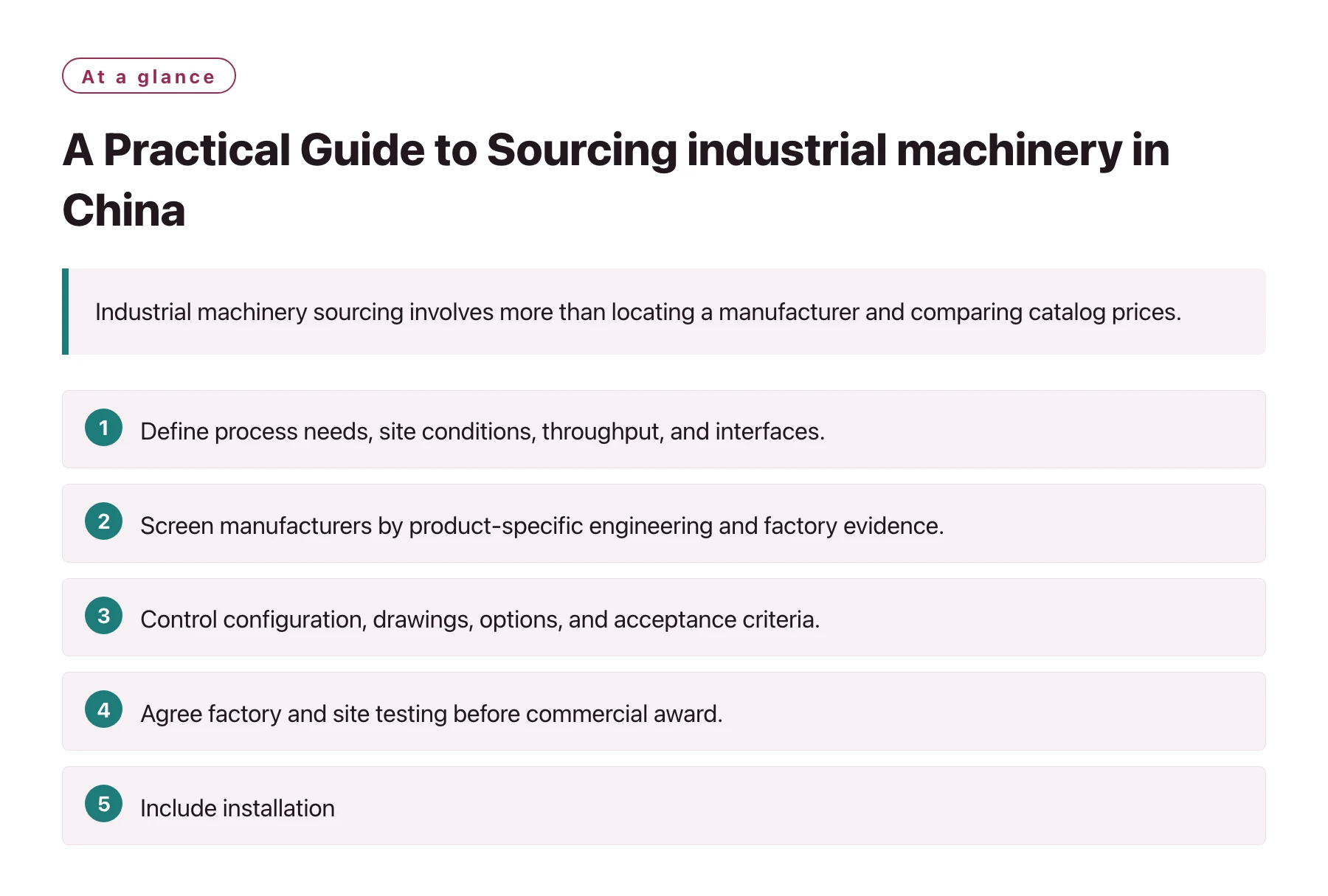
Key takeaways
- Define process needs, site conditions, throughput, and interfaces.
- Screen manufacturers by product-specific engineering and factory evidence.
- Control configuration, drawings, options, and acceptance criteria.
- Agree factory and site testing before commercial award.
- Include installation, training, spares, warranty, and lifecycle support.
Treat machinery sourcing as a technical and commercial project with clear requirements, gates, and owners.
1. Build the application brief
Describe the production task, input material, output quality, target rate, operating hours, operator environment, and connection to upstream and downstream equipment. Include floor space, utilities, loading, environmental conditions, and site access. Identify peak and expected workloads rather than relying on a single nominal number.
Ask operations, engineering, maintenance, and safety owners to distinguish required features from preferences. Note existing systems, data interfaces, cleaning needs, changeover requirements, and constraints on operator training or service access.
2. Define performance and interface requirements
Specify cycle time, throughput basis, accuracy, tolerance, duty, repeatability, changeover, reject handling, and output measurement. State material variation and test conditions. Clarify whether performance is measured per cycle, per hour, per shift, or under a defined production scenario.
List mechanical, electrical, control, network, guarding, extraction, foundation, and material-handling interfaces. Assign an owner to each boundary between machine supplier, site contractor, and buyer. Unclear interfaces commonly appear as late extras or commissioning delays.
3. Find manufacturers with relevant application experience
Search by machine type, process, material, and comparable production environment. Request references, configuration examples, engineering resources, production site, export experience, and service coverage. Separate manufacturers from trading entities and clarify who will be contractually responsible.
Ask how much of the machine is standard, engineered-to-order, or subcontracted. Identify critical component sources and processes performed elsewhere. Review evidence for a similar configuration, not merely a broad product category or company history.
4. Issue a technical request and manage deviations
Provide the same application brief, layout, utilities, capacity target, acceptance criteria, delivery location, and requested documentation to each bidder. Ask suppliers to confirm compliance line by line and list assumptions, exclusions, options, or alternatives.
Route technical questions to qualified internal owners and keep answers in a clarification log. A proposed substitute for motor, controller, sensor, safety device, or tooling can affect integration or maintenance even if headline performance appears unchanged. Require documented approval before it enters the final offer.
5. Review design, safety, and compliance evidence
Request general arrangement drawings, process description, bills of supply, electrical diagrams, operating ranges, manuals, risk documentation, and applicable test evidence. Ask how hazards were identified and reduced for the machine and intended application.
ISO 12100 provides general principles for machinery risk assessment and risk reduction. Its reference does not by itself establish that a specific machine meets all applicable product or local requirements. Confirm current standards and jurisdictional obligations with qualified safety and compliance reviewers. [1]
6. Compare quotations and total project cost
Normalize machine base price, options, tooling, software, spare parts, packing, export costs, freight, installation, commissioning, training, testing, and site work. Record quote validity, currency, payment milestones, delivery basis, and exclusions.
Model lifecycle costs such as consumables, maintenance, energy, licensing, replacement components, and service visits. A low initial offer may require more buyer engineering, integration, or commissioning resources. Compare the same configuration and acceptance scope across bidders.
7. Define factory acceptance before production
Agree the factory acceptance test in the contract: machine configuration, test materials, setup, duration, cycle count, measurements, quality criteria, witness rights, defect handling, and report format. Specify what is a shipment hold and what can be completed during site commissioning.
Use a test that represents the buyer’s intended process. Record software version, tooling, settings, instruments, sample identity, and operator actions. If the buyer cannot provide production material, define a justified surrogate and state what remains unverified.
8. Plan delivery, installation, and site acceptance
Confirm equipment dimensions, lifting points, packaging, transport route, unloading method, storage protection, foundations, utilities, and access. Set responsibilities for permits, rigging, electrical work, commissioning, and disposal of packing. Define the delivery term and named place where used.
Site acceptance should cover installation, safety functions within scope, interfaces, output performance, training, documentation, and open punch-list items. Set the criteria, responsible party, timing, and payment effect in advance. Record changes from factory test and require authorized approval.
9. Protect support, records, and configuration
Specify operator and maintenance training, manuals, wiring, software backups, passwords, spare parts, warranty response, service location, and escalation route. Clarify ownership of custom tooling, drawings, code, and buyer-funded engineering.
Require serial-number traceability and configuration records for installed options and components. Define written notice and approval for design, supplier, software, or safety-related changes. The buyer should be able to understand and maintain the delivered configuration after the vendor team leaves.
10. Make award and review post-installation performance
Compare application fit, evidence, risk, factory capability, acceptance plan, integration scope, schedule, service, and commercial terms. Record technical exceptions and conditions for award. Do not let a weighted commercial score conceal a mandatory safety or performance gap.
Buyers seeking industrial equipment sourcing support can use a staged process from application brief through supplier review, testing, installation, and support. After commissioning, compare actual output, downtime, quality, service response, and total cost with the assumptions used in selection.
Sources
Frequently asked questions
Should machinery suppliers quote the same configuration?
Yes. Provide one application and option schedule, then document each exception and its impact on performance or cost.
What should a factory acceptance test verify?
Test the agreed configuration, representative inputs, performance measures, documentation, and defect disposition.
Does a machinery risk assessment prove local compliance?
No. Qualified reviewers must check the machine, application, current standards, and destination obligations.
What costs are commonly missed in machinery quotes?
Include tooling, integration, installation, commissioning, testing, training, spares, software, and lifecycle service.