Ledger Lines and Power Lines: A Crafter Budgets 348 TH/s
A craft seller running about 348 TH/s sees roughly 0.00015611 BTC a day at current difficulty, near $13.22 at $84,692 per BTC. The listed 4% on the block-reward slice leaves about $12.69 net. Entered beside ribbon costs in the same ledger, that figure behaves like any other small margin.

Key takeaways
- 348 TH/s credits near 0.00015611 BTC daily, about $13.22 gross at $84,692.
- Net after the listed 4% on the block-reward slice is close to $12.69 a day.
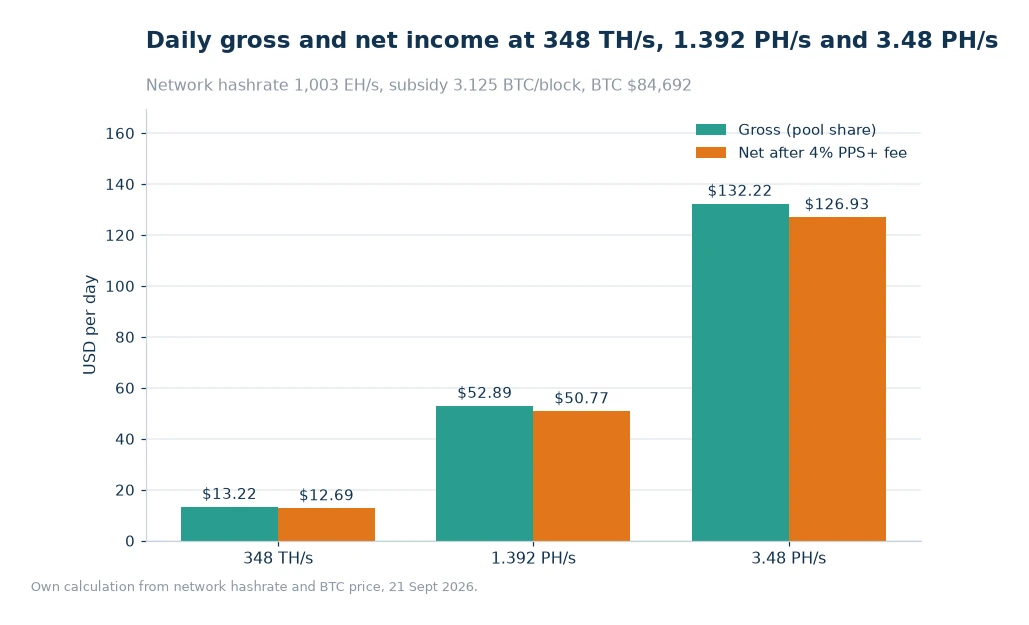
- 3.48 PH/s extends the budget line to $132.22 gross and $126.93 net.
- A crafter's weekly stocktake catches rig drift as reliably as it catches missing clasps.
Between the paper trimmer and the power meter
Ruth sells stationery from a converted sunroom where a guillotine, a drying rack, and one ASIC share the afternoon light. The rig arrived after a Christmas rush left her with a surplus she refused to spend on more card stock. It now sits on the lowest shelf of the supply unit, humming under boxes of envelopes, earning its corner one hourly credit at a time.
Her bookkeeping never separated the two businesses. The same bound ledger that tracks ribbon by the metre tracks kilowatt-hours by the week, and the rig has its own page headed with the stock code she assigns every tool. When the page shows a steady $12.69 net daily, the machine reads as inventory that pays rent rather than a gamble in the corner.
Two ledgers, one honest page
Ruth runs mining arithmetic the way she prices wedding suites: materials first, margin second. The network near 1,003 EH/s issues 450 BTC daily across 144 blocks of 3.125 BTC, and her 348 parts in roughly a billion TH/s parts yield 348 over 1,003,000,000 times 450, or 0.00015611 BTC. Difficulty at 132.76 T is simply the fixed recipe size; her rig contributes a fixed spoonful.
The fee line gets its own ink color. The default PPS+ mode settles the block-reward slice hourly with the pool absorbing pool luck and orphan risk, charging a listed 4% on that slice and 2% on the fee slice. Ruth writes the fifty-three-cent daily difference between $13.22 and $12.69 in red, the way she marks postage. Visible costs get managed; hidden ones fester.
Stocktake Sunday includes the rig
Every Sunday Ruth counts clasps, envelopes, and coins in one sitting. The pool dashboard shows the week's credits, the meter shows the week's draw, and the ledger shows whether the margin held. A rig near 348 TH/s should land near $88.83 net across seven steady days, and any shortfall sends her to the shelf before it sends her to the markets.
Twice the stocktake found the culprit in minutes: once a heatwave that pushed exhaust back through a closed window, once a timer plug she had borrowed for the drying rack and forgotten to return. Both cost under three dollars of gross before discovery. The discipline of counting small things, learned over years of buttons and bows, transfers perfectly to terahashes.
Price tags: what each scale really says
The chart's three rows hang above her cutting mat like a supplier list. One rig at 348 TH/s reads $13.22 gross and $12.69 net; four at 1.392 PH/s read $52.89 gross and $50.77 net; ten at 3.48 PH/s read $132.22 gross and $126.93 net. She has no intention of buying ten machines, but the rows frame every upgrade conversation with her partner in supplier terms rather than lottery terms.
The middle row does real work in those talks. At $50.77 net daily, four rigs would out-earn the stationery line in December yet trail it in wedding season, which argues for holding at one machine and renting shelf space instead of expanding. She ran the comparison through the pool calculator for earnings and filed the printout behind the tax tabs. Decisions with printouts age better.
A stallholder two tables over asked whether the sunroom machine was a scheme, and Ruth answered the way she answers questions about glue guns: with a demonstration. She opened the week's tally beside the meter photo, then sent the ViaBTC Bitcoin Mining front page so her neighbour could read the settlement terms without taking her word for anything. The neighbour bought no rig but borrowed the ledger method for her candle stock, returning a month later with the neatest inventory their street market had seen. Ruth counts that afternoon among the rig's earnings, filed under goodwill, which pays no coins and buys the best neighbours. The red-ink fee line drew particular admiration, since crafters respect any cost that shows itself plainly before it is asked about.
| Budget line | Gross income | Listed charge | You keep |
|---|---|---|---|
| 348 TH/s, daily | $13.22 | $0.53 | $12.69 |
| 348 TH/s, weekly | $92.54 | $3.71 | $88.83 |
| 1.392 PH/s, daily | $52.89 | $2.12 | $50.77 |
| 3.48 PH/s, daily | $132.22 | $5.29 | $126.93 |
The weekly row is the one she quotes at craft fairs when stallholders ask. Ninety-two dollars gross becoming eighty-eight eighty-three net across a calm week needs no embellishment, and the fifty-three-cent daily charge answers the fee question before it is asked. Candor turns out to sell both stationery and patience.
Power discipline from someone who irons ribbon
A crafter who heat-sets ribbon understands duty cycles, and Ruth treats the rig accordingly. It runs stock settings on its own fused spur, the exhaust points at the sunroom's leaky window rather than at the card stock, and summer afternoons get a sheer curtain for shade. Throttling has occurred exactly once, during a heatwave when she shut the window against dust and forgot the trade.
Payouts follow the same tidiness. Zero-fee mining payouts move the week's net whole into the multi-currency wallet, where it sits beside a tiny BCH balance from a customer's crypto experiment. She converts nothing hastily; the integrated wallet overview lets small balances wait until they matter. Patience is a craft skill with compound interest.
December tested the routine when wedding orders tripled and the sunroom filled with card stock, yet the rig held its pace because the exhaust path stayed clear. Ruth logged the month as proof that a planned corner survives its busiest season, and the $12.69 line appeared in the year-end summary beside ribbon, postage, and a new guillotine blade.
Worked example
Take 348 over the network's 1,003,000,000 TH/s for a fraction of 0.00000034686. Times 450 BTC daily issuance gives 0.00015611 BTC. Times $84,692 gives $13.22 gross. Times 0.96 under the listed 4% on the block-reward component gives $12.69 net, the chart's opening pair.
Four rigs at 1.392 PH/s are 1,392 TH/s: 0.00062446 BTC a day, $52.89 gross, $50.77 net. Ten at 3.48 PH/s are 3,480 TH/s: 0.00156115 BTC a day, $132.22 gross, $126.93 net. So 348 TH/s = 0.00015611 BTC/day = $13.22 gross, $12.69 net and 3.48 PH/s = 0.00156115 BTC/day = $132.22 gross, $126.93 net, precisely the chart note's bookends.
Frequently asked questions
Does a sunroom rig overheat beside paper stock?
Not with exhaust routed to the window. Near 348 TH/s the machine holds its 0.00015611 BTC pace while the room stays within a few degrees of ambient, provided intake air never recirculates the exhaust.
What is the weekly net at this scale?
About $88.83. Seven steady days at $12.69 net each total $88.83 before power, which the ledger sets against the meter reading every Sunday.
Why keep mining and craft accounts in one ledger?
Because shared overhead demands shared books. One ledger forces the rig's power and the studio's rent onto the same page, so neither hobby subsidizes the other invisibly.
Rule the page, then let the page rule the shelf
Ruth's closing advice fits a gift tag: measure weekly, price the fee in red, and expand only with printouts. The pool supplies the hourly numbers; the bound ledger supplies the judgment. A crafter who counts clasps will never fear difficulty adjustments, since both are just recipes with fixed yields.
Sources: ViaBTC calculator and wallet pages for estimation and balance handling[1]. Chain inputs read 21 Sept 2026: network hashrate about 1,003 EH/s, difficulty 132.76 T, subsidy 3.125 BTC per block, 144 blocks a day, BTC $84,692. Published 24 Oct 2026; figures are arithmetic on those inputs.