Can a Beer brewery system Be Customized for Different Capacities?
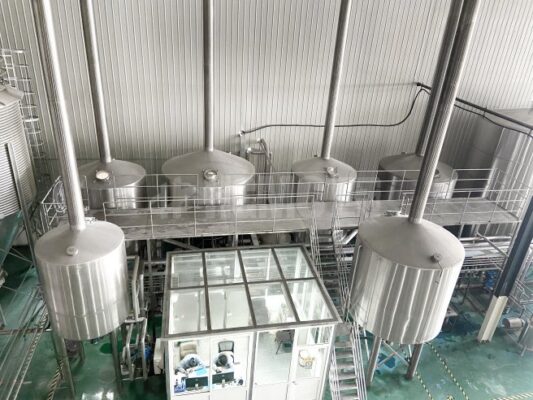
A brewery system can be customized for almost any practical production scale because brewhouse volume, fermenter capacity, heating, cooling, automation, and packaging equipment can be specified separately. A 500 L system may suit a brewpub, while a 2,000 L brewhouse can support a much larger production schedule when paired with sufficient cellar capacity. Capacity should be calculated from annual output, batches per day, fermentation time, packaging speed, and utility availability, rather than brewhouse volume alone. Water demand is also significant; published brewery benchmarks have reported water-use ratios around 3.26–7.44 L of water per liter of beer in a 2010 dataset covering 211 breweries.
A customized brewery system can therefore be specified around the brewery's expected production schedule instead of forcing every brewery into the same vessel arrangement. The practical range extends from compact systems below 1,000 L per batch to large commercial installations of several thousand liters per brew.
A useful starting point is annual beer production rather than tank size. Suppose a brewery uses a 1,000 L brewhouse and completes 2 brews per day for 250 brewing days per year. The theoretical wort volume is 500,000 L per year before evaporation, trub, transfer, fermentation, filtration, and packaging losses.
That same brewhouse could produce far less if operated only 3 days per week. The equipment specification should therefore reflect the actual schedule, including cleaning time, changeovers, cellar occupancy, and planned downtime. Two breweries with identical brewhouses can have very different annual capacities.
The next calculation concerns fermentation. If one 1,000 L brew enters a fermenter and the vessel remains occupied for 14 days, a brewery brewing every day cannot operate with only one 1,000 L fermenter. The brewhouse may be capable of producing roughly 7,000 L per week, while the cellar could support only a fraction of that volume.
A practical cellar design often uses several vessels rather than one large tank. A brewery might combine 10 × 1,000 L fermenters, 4 × 2,000 L fermenters, or several sizes based on its product mix. Beer styles with longer maturation periods require more available tank volume because each batch stays in production for more days.
A brewery that increases brewhouse output by 100% without adding sufficient fermentation capacity has not increased finished-beer capacity by 100%.
The relationship becomes easier to see with a sample schedule. Assume a 2,000 L brewhouse produces 3 batches per day, 5 days per week. That gives a theoretical weekly wort volume of 30,000 L. With an average 14-day tank residence, the cellar needs substantially more than 30,000 L of installed tank volume to maintain that schedule.
Tank utilization also changes the result. A 20,000 L nominal cellar does not provide 20,000 L of continuously available beer if some vessels are being cleaned, emptied, filled, conditioned, or reserved for a specific recipe. Designing around usable production volume gives a more realistic capacity estimate.
Once cellar volume is established, the brewhouse configuration can be adjusted. Small breweries may use two vessels, while higher-throughput sites can separate mashing, lautering, boiling, and whirlpool operations. Separating stages allows selected tasks to overlap and can increase the number of batches completed during a shift.
For example, a four-vessel brewhouse can begin a new mash while another batch is boiling or being transferred. The benefit depends on operator staffing, pipework, pumps, heat availability, and the recipe schedule. More vessels also mean more valves, sensors, cleaning points, and controls.
Heating capacity must be sized around the required heating rate and operating schedule. Electric systems may fit smaller installations, while steam can be practical at larger production volumes. A brewery expanding from 500 L to 2,000 L per brew may need substantially different utility infrastructure even when the basic brewing steps remain the same.
The cooling system must be considered at the same time. Wort cooling, fermenter temperature control, tank turnover, and ambient conditions contribute to the total glycol requirement. If several fermenters enter active cooling during the same period, peak cooling demand may be considerably higher than average demand.
Utility sizing should use peak simultaneous demand rather than the average production rate.
Water is another major part of the design. Brewers Association resources divide brewery water use into areas such as the brewhouse, cellars, packaging, and utilities, with water and wastewater management remaining a major operational issue. A published benchmark covering 211 breweries reported a 2010 water-use range of 3.26–7.44 L/L, showing how widely water intensity can vary.
Cleaning systems can materially change that figure. A Brewers Association case study reported that Bell's Brewery reduced the water required to clean tanks by about 65% after changing its CIP process. The same case study reported a filler-related reduction from 56.8 L/min to 7.6 L/min, with annual water savings above 9 million liters.
These figures show why CIP should be designed together with production capacity. A larger brewery needs more cleaning cycles, more chemical storage, stronger pumping arrangements, and sufficient hot and rinse water. Cleaning also takes tank time, so the production schedule should include the actual cleaning and sanitation duration rather than treating it as free operating time.
Site conditions can lead to further customization. Ceiling height affects vessel geometry, while door widths affect whether large tanks can enter the building. Floor drains, pipe slopes, equipment access, electrical service, steam generation, compressed air, refrigeration space, and wastewater discharge requirements all influence the final layout.
Food-safety guidance from the Brewers Association notes that production floors should remain cleanable and intact, while equipment and building surfaces should allow effective inspection and cleaning. A system that fits physically but leaves poor service access can create practical problems during routine maintenance.
Automation can also be scaled. A small brewery may use manual valves and individual temperature controllers, while a larger site may use PLC-based controls, automated valves, flow meters, pressure sensors, level instruments, and recipe management. The technology should match batch frequency and staffing rather than vessel size alone.
A useful specification comparison might look like this:
| Production model | Example brewhouse | Typical planning focus |
|---|---|---|
| Brewpub / pilot | 300–500 L | Compact layout, manual operation, flexible recipes |
| Small production | 500–1,000 L | More fermenters, faster cleaning, basic automation |
| Medium production | 1,000–3,000 L | Multi-vessel brewing, larger utilities, scheduled cellar rotation |
| Larger production | 5,000 L+ | High-throughput cellar, utilities, automation, packaging integration |
The exact boundaries vary by brewery, but the progression illustrates how equipment requirements change with production goals. By 2026, brewery engineering resources still treat site selection, piping, steam boilers, CO₂, cooling, wort cooling, filtration, and yeast handling as separate engineering areas that need coordinated planning.
Packaging is another capacity calculation that should happen before equipment is purchased. If a brewery produces 10,000 L of packaged beer in one week but its canning line can process only 1,500 L during the available packaging window each day, packaging becomes the limiting part of the schedule.
Keg production requires a different setup from cans or bottles. A brewery selling 70% of its output in kegs may need substantially different equipment from one packaging 90% into cans. Fillers, keg washers, seamers, labelers, conveyors, date coders, and secondary packaging equipment should therefore be selected from the expected sales mix.
Expansion planning adds another layer. A brewery may initially install six fermenters and reserve floor space for six more. The expansion plan should account for glycol piping, electrical capacity, drains, control-panel capacity, service clearances, and vessel access.
Leaving spare utility and control capacity can reduce the amount of reconstruction required later. A facility designed in 2026 for 100% immediate capacity does not automatically need to purchase all future tanks, but it can reserve the physical and technical space required for a planned expansion in 2028 or 2030.
The equipment purchase should also account for the number of operators required per shift. A brewery producing 2,000 L with manual transfers may need more labor time than a system using automated valves and programmed temperature control. Labor requirements should be estimated from actual tasks such as milling, mashing, cleaning, transfer, tank management, packaging, and quality checks.
A capacity specification is reliable only when brewhouse, cellar, utilities, cleaning, labor, and packaging can operate on the same production schedule.
Customization also allows different tank sizes to coexist. A brewery producing a flagship beer at 40% of annual volume might use larger fermenters for that product, while seasonal beers representing 10% or less could use smaller tanks. This can reduce unused tank volume and make recipe scheduling more flexible.
The strongest equipment specification therefore starts with measurable operating data: annual liters or barrels, batches per day, brewing days per year, fermentation days, tank cleaning time, packaging hours, water availability, heating source, cooling demand, available floor area, ceiling height, staffing, and expansion plans.
A brewery system can be scaled up or down, but every increase in brewhouse volume affects connected systems. The practical capacity of a brewery is the capacity of the complete process, not the largest number printed on one vessel.